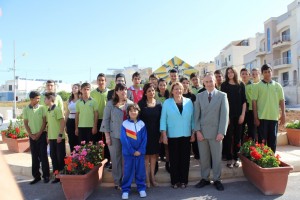
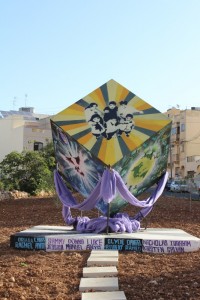
 The Cube of Life is a collaborative graffiti art project between Maria Regina College and graffiti artist James Micallef Grimaud. This project was funded by the Office of the President of Malta under the scheme of “Il-Premju tal-President għall-Kreattivita” through the initiative of the College Youth Worker, Anna Maria Grech. The 6-faceted cube illustrates few of the basic Human Rights which the participating students and young people considered to be most important.
The cube was installed in Karlo Darmanin Street in Mosta with the help and support of the Mosta Local Council on the 9th of November 2013 and was completed by April 2014. The participating students from both Maria Regina Boys’ and Girls’ secondary schools have met regularly with Mr. Micallef Grimaud, the youth worker and myself, throughout this period, and following numerous sessions of brainstorming and discussion, practical sessions were held at Maria Regina College and at the Mosta Youth Empowerment Centre to plan their work and to finalise the stencils needed. Subsequent sessions were then held on site where the cube was installed, so as to spray paint each side using the stencils prepared.
From the thirty basic Human Rights specified by the Universal Declaration of Human Rights in 1948, the students taking part in the project chose to focus on the following:
- The Right to Seek a Safe Place to Live
- A Fair and Free World
- The Right to Education
- The Right to Play
- Freedom to Move
Besides illustrating various Human Rights, each side was also made more visually interesting by having a distinct colour making up a complete colour chart of both primary and secondary colours. The most prominent side symbolises the united power that youth and future generations have. This facet portrays a powerful image of the group of young people united together to safeguard Human Rights. The adjacent side is about ‘The Right to Seek a Safe Place to Live’ emphasising the importance of living in a healthy environment. This side depicts the world surrounded with that which is considered both natural and beneficial to our ecosystem and that which is man-made, polluting and hazardous. Through such images the viewers are made aware of the surroundings which they live in and perhaps lead us to appreciate our environment more.
Its adjoining side tackles the right for ‘A Fair and Free World’, focusing on the importance of peace in one’s country. This facet displays a series of contrasting symbols of both war and peace including bombs, weapons of destruction, and a white dove. On the back side of the cube we find illustrated ‘The Right to Education’ which focuses mostly on its cyclical nature and on the symbol of wisdom, the owl. This side illustrates one’s journey in education from primary to secondary and tertiary education, the world of work and finally old age. It is precisely towards this end of the cycle that the viewer is made aware of how the older generation has the potential to teach the younger ones even through old age, thus making the education cycle an on-going and continuous process.
Connected to this side is another portraying ‘Freedom to Move’ where the central image is that of someone pulling apart iron prison bars with light shining through, symbolising freedom. Surrounding this image one can see various common means of transport including helicopters, planes, cars, buses, motorcycles, boats and people walking. The remaining sixth side represents ‘The Right to Play’ and the importance of leisure activities. It is only by dedicating enough time to such activities that one can lead a healthy and productive life. Some of the images integrated in this side include that of a policeman, nurse, doctor, judge, mechanic, scientist and farmer. The former set of images displaying work life were subsequently complemented with images of the recreational activities that are needed to maintain a steady and optimum level of performance at work. The leisure activities illustrated were: a scene at the beach, reading books, riding a BMX bike, playing football and going for a car ride.
Besides generating more awareness on our basic human rights, the Cube of Lifealso provided all the contributing participants the opportunity to work and learn together as a team. This project has made it possible for a multi-disciplinary team (youth worker, artist, teachers, learning support assistant, students and young people from the community) to come together to discuss new ideas and to find means to visually illustrate and develop these through graffiti art.
LEARN YOUR HUMAN RIGHTS:
1. We Are All Born Free and Equal
2. Don’t Discriminate
3. The Right to Life
4. No Slavery
5. No Torture
6. You Have Rights No Matter Where You Go
7. We’re All Equal before the Law
8. Your Human Rights Are Protected by Law
9. No Unfair Detainment
10. The Right to Trial
11. We’re Always Innocent Till Proven Guilty
12. The Right to Privacy
13. Freedom to Move
14. The Right to Seek a Safe Place to Live
15. Right to a Nationality
16. Marriage and Family
17. The Right to Your Own Things
18. Freedom of Thought
19. Freedom of Expression
20. The Right to Public Assembly
21. The Right to Democracy
22. Social Security
23. Workers’ Rights
24. The Right to Play
25. Food and Shelter for All
26. The Right to Education
27. Copyright
28. A Fair and Free World
29. Responsibility
30. No One Can Take Away Your Human Rights
http://www.youthforhumanrights.org/what-are-human-rights/videos/born-free-and-equal.html